[this page is still under construction :)]
- Pod Mapping
- Showing Up for Yourself
- Allowing Community to Show Up for You
- Nervous System Regulation Tools
- Care Toolkits
- Non-Carceral Hotlines & Support Spaces
Many of us struggle to ask for support and to talk about our needs. We have been conditioned under racial capitalism to be un-needy and hyper-independent, to detach from our humanity and bodyminds, and to abandon collective care for individual preservation. These survival strategies are cultivated by ableism and white supremacy to foster complacency (via burnout), relational rupture, and disposability—some of the largest threats to our movements today.
Through the wisdom and lived experiences of Sick, Mad, neurodivergent, and disabled community members, we have learned that identifying our needs and naming how we desire care, both day-to-day and in moments of crisis or symptom exacerbation, can allow communities to show up for each other with consent, to meet the moment, and to build infrastructure for sustainable movements.
When we are in a place of crisis, our activated nervous system prioritizes information relevant to our immediate safety, and our knowledge of available resources and tools can become more difficult to access. Thinking about how we want to be cared for and what support we have access to before we are in crisis or burnout, allows our brains to better access and remember that information, to identify resource gaps and create alternatives, to rebuild our capacity, and ultimately, to practice collective liberation.
Pod Mapping
Pod mapping is a framework developed by Disability Justice and Transformative Justice elder, Mia Mingus.
A pod is a group of people or a community who can come together, who can turn to each other for support. People may have multiple pods for different reasons and lengths of time. Pods can be formed in response to violence, for accountability, for crises, for mutual aid, for life events, for care planning, and more.
- Put yourself in the middle gray circle.
- In the bold-bordered circles, place direct relationships or individual resources that you have that can offer you support. Use people’s names rather than vague descriptions.
- In the circles with dashed-line borders, place relationships or resources that still need some tending to or could be moved in as needed.
- In the outermost circles, write organizations or institutional resources.
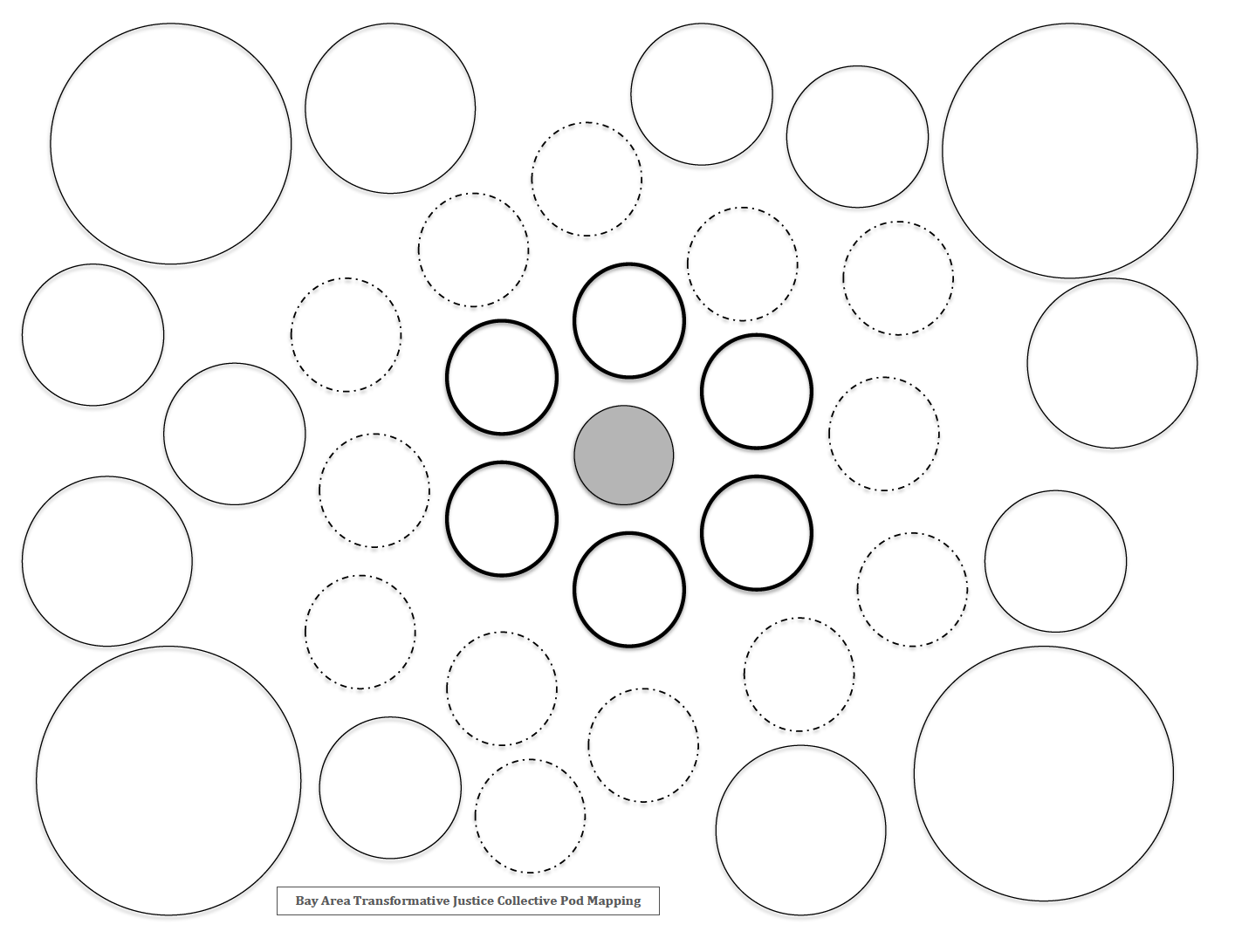
We encourage you to learn more about pod mapping through the SOIL Transformative Justice Project and the Bay Area Transformative Justice Collective.
Showing Up for Yourself
How do you like to decompress after a stressor?
What triggers are you concerned about? (consider ideation, self-harm, substance use, etc.)
What are signs that you are feeling unwell, activated, or burnt out?
What has felt supportive in the past when you felt unwell or in crisis? What has not?
What skills and tools can you access when you are overwhelmed?
How can you build a regular practice for regulating your nervous system?
What/who is in your crisis plan/toolkit?
Allowing Community to Show Up for You
What are your debriefing/aftercare needs for a stressful event?
Who can you ask for reminders to eat, hydrate, take medications, etc.?
Who can you ask for support with household or care tasks?
Who can you ask for support with distraction?
Who can you ask for emotional support (listening, validation, mirroring, etc.)?
Do you have any access needs/triggers that you want others to know about?
How do you want your support people to approach you or care for you when you are feeling unwell or they are concerned about your mental health?
Nervous System Regulation Tools
Below is a list of some nervous system regulation tools that have been helpful in our experience as street medics.
We name that many of these tools were co-opted by the psychiatric industrial complex from the healing practices of indigenous communities around the world. We hold that some of these tools may not be accessible to everyone, may be associated with therapeutic modalities that have harmed oppressed communities, and/or may not be safe for some people to use in their bodies in public spaces.
TIPP: Temperature, Intense exercise, Paced breathing, Paired/Progressive muscle relaxation
- Temperature: Splash face with cold water or place an ice pack on pulse points
- Intense Exercise: Release built-up energy with movement that feels safe and accessible for you
- Paced Breathing:
- Reset Breath: Take 2 consecutive breaths through your nose: one long deep inhale and one short deep inhale, with no exhale in between, to fully inflate your lungs. Exhale through the mouth with pursed lips until your lungs are empty.
- Box Breath: Inhale for 4 counts. Hold your breath for 4 counts. Exhale for 4 counts. Hold your breath for 4 counts. Repeat.
- 4-7-8 Breath: Inhale through your nose for 4 counts. Hold your breath for 7 counts. Exhale through your mouth for 8 counts. Repeat.
- Paired/Progressive muscle relaxation
PLEASE: Physical iLlness, Eating/hydrating, (Avoid or access) substances, Sleep, Exercise/movement
Addressing core physical needs can offer support in reducing stressors on the body and a place to start when overwhelmed.
- Physical Illness: Am I physically unwell? Have I taken my routine medications? How can I offer support to any pain, discomfort, or other symptoms that are present for me?
- Eating/Hydrating: Have I eaten today? Have I met my nourishment goals? Have I hydrated recently?
- Avoid or Access Substances: How is my body responding to substances I have taken? Would engaging in substance use align with my needs and goals? How can I access the substances I need or that feel supportive to me? If my goal is to avoid engaging in substance use, what can support me in meeting that goal?
- Sleep: Have I gotten enough sleep? How can I facilitate rest for myself?
- Exercise/Movement: Have I moved my body in ways that feel good and meet my needs? Could I channel some stored energy into movement that feels accessible to me?
Bilateral Stimulation
- Visual bilateral stimulation tool for Eye Movement Desensitization and Reprocessing therapy
- Butterfly Tapping: Cross your arms over your chest, as if giving yourself a hug. Tap your arm or shoulder, while alternating hands (right hand to left arm, left hand to right arm).
- Audio panning
Sensory Grounding
These tools can be adapted for folks with fewer senses.
5-4-3-2-1
- Name 5 things you can SEE
- Name 4 things you can TOUCH
- Name 3 things you can HEAR
- Name 2 things you can SMELL
- Name 1 thing you can TASTE
RAINBOW Grounding: Observe your surroundings and name one object for each color of the rainbow.
Sensory Soothing or Processing
- SIGHT: favorite movie or TV show, memes, or cute animal videos
- TOUCH: Deep pressure therapy with a weighted blanket, fidget tools, stim toys
- SOUND: Comfort playlist, singing/humming, ASMR
- SMELL: Aromatherapy
- TASTE: Sour candy, comfort foods
Vagus Nerve Reset
- Focus your gaze straight ahead and take a few deep breaths, into your belly using your diaphragm.
- While keeping your head facing forward, look to the periphery of your vision for 30 seconds until you feel the urge to sigh, yawn, or swallow.
- Then repeat and look to the periphery of your vision on the other side.
- Return your gaze to the center and take a deep breath to close the exercise.
Care Toolkits
Crisis Planning
- NYCAM Care/Crisis Planning Worksheets
- Jasmin Ariel’s Communication & Capacity Support Toolkit
- Project LETS Anti-Carceral Crisis and Safety Planning
- Fireweed Collective Mad Mapping
- Transformative Mutual Aid Practices (T-MAPs)
- A Life Worth Living: Suicide Care Plan
- PDX Queer Death Collective Grief Crisis Plan
Chronic Illness
- Scarleteen Care Web Toolkit
- Chronic Illness Care Plan
- Hyp+ Access Full Health Summary Template
- Hyp+ Access Emergency Info Template
Long COVID
Other
- Stefanie Lyn Kaufman-Mthimkhulu’s Birth Support Access Cards
- Safety Planning Strategies for Survivors
- Pamela Raphael’s Relationship Boundary Mapping
- CURCUM’s Trees: A Decolonial Healing Guide for Palestinian Community Health Workers
Non-Carceral Hotlines & Support Spaces
- Trans Lifeline: 877-565-8860
- Blackline: 800-604-5841
- Wildflower Alliance Peer Support Line: 888-407-4515
- Thrive Lifeline: 313-662-8209, Text “THRIVE” 24/7
- Yarrow Collective’s Alt2Su Group and 1:1 Peer Support
- Peer Support Space
- Psychiatric Incarceration Support Line: 401-400-2905

