Street medics provide varying types of care in varied conditions, outside of the frameworks of medical-industrial complex. Street medics may provide action medical services such as emergency first aid at protests, encampments, building or site takeovers, marches, direct action, or other sites of conflict with state or non-state violence workers. Street medics also may offer community medicine, working in pop-up clinics, doing mutual aid disaster relief, attending jail support, or providing other direct community care.
One of the animating values of street medicine is the decolonization and democratization of medical care. Besides providing care, street medics train community members in basic and critical first aid, as well training community members and medical personnel to become new street medics.
Philosophy
Organizing a training can be deceptively complex — it’s where logistics, pedagogy, and prefigurative politics[1] meet.
NYCAM views trainings through a liberation pedagogy lens. That is, we do not consider education to be simply a transfer of information from teacher to student, but rather the intentional facilitation of relationships between life-long learners with different levels of expertise and exposure to various subjects and processes. Every participant, whether an experienced medic or layperson, brings valuable life experience into the learning space, along with positional advantages and disadvantages, biases and insights, cultural sensitivities and ignorances, and NYCAM believes that creating and holding a space for this relational work is a fundamental part of facilitating learning.
NYCAM believes that training:
- can accommodate participants with a variety of learning styles;
- can be a form of relationship and community building;
- can be accessible to people with varying schedules, commitments, and finances;
- can be nourishing as opposed to draining;
- can be rigorous and collaborative as opposed to tedious and competitive;
- can be empowering as opposed to humiliating.
[1] Prefigurative politics: organizing in the shape of the world we wish to create, e.g. consensus or sociacratic decision-making, non-hierarchical group structures, a 4-day work week, non-carceral conflict management, people over productivity, etc.
- For an easy introduction to prefiguration, check out this podcast: Prefigurative Politics and Workplace Democracy w/ Saio Gradin and Nicole Wires.
- Also see: Prefigurative Politics in Practice: Examples and Strategies.
- For a more in-depth reading on the subject, check out Raekstad, Paul & Gradin, Sofa Saio. Prefigurative Politics: Building Tomorrow Today (Cambridge: Polity Press, 2020).
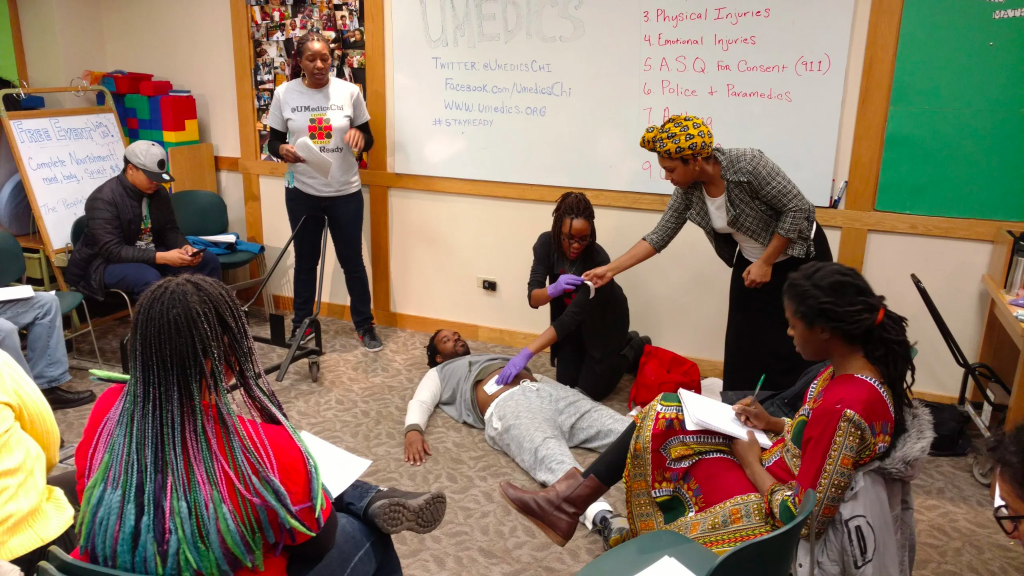
Source: Maya Dukmasova
 New York City Action Medical