Table of Contents
- I’m not a street medic. How can I help?
- How do I become a street medic?
- How do I join NYCAM’s Dispatch?
- How do I become an organizing member of NYCAM?
- How do I find my local street medic collective outside of NYC?
- How do I find medics at an action?
- What are some practices I should or shouldn’t expect of NYCAM-trained medics?
- I had a negative experience with a street medic. What do I do?
- Is it true that you can use [not water] to help someone who has been pepper sprayed or tear gassed?
Source: DC Street Medic Collective
I’m not a street medic. How can I help?
NYCAM believes in and lives by the prefigurative politics of building a new world as we fight the current one. You don’t have to be a street medic to offer care to your community.
Start by listening.
- Tap into your local mutual aid distro.
- Ask an immigrant neighbor if you can purchase groceries for them or pick up their kids from school.
- Print red cards for your students or coworkers.
- Take on a care shift for a disabled community member.
- Organize a grief circle or debrief space to acknowledge and hold what is happening in our world.
- Offer to facilitate childcare or interpret language at skillshares, workshops, and trainings.
- Make care packages or home-cooked meals for frontline organizers.
- Start a group chat with other tenants in your building to strategize around housing concerns.
- Give someone a ride to their next vaccine appointment or accompany them to a doctor’s visit as their healthcare advocate.
- Offer to remotely hold emergency contacts and jail support plans for friends going to protests.
- Consider bringing high-filtration masks, squirt-top water bottles, and allergen-friendly snacks to the next direct action you attend.
- If you have medical training and it is within your scope, consider setting up a regular free clinic table and offering wound care, medical supplies, or blood pressure/blood glucose testing.
- Mobilize your neighbors, friends, and community members to do the same.
Our movement ecosystem has many roles to be filled, from storytellers to disrupters to care workers to supply transporters to court watchers. People fighting will always need “full bellies to think and safe places to gather” (“Miss Bell and the Marchers,” p. 77, Brown Girl Dreaming by Jacqueline Woodson).
How do I become a street medic?
Street medic training is a 20-28 hour course for non-medical professionals and a 6-8 hour bridge course for medical professionals.
Bridge trainings are open to providers with direct patient care experience and clinical training (including physicians, nurses, physician assistants, wilderness first responders, certified first responders, EMTs, paramedics, and medical/nursing students).
To qualify for a bridge training, you must have knowledge of:
- Body substance isolation
- Basic wound care
- C-spine injury and stabilization
- Assessing mental status and level of responsiveness
- Airway and breathing interventions
- Triage
- Physical exams
- Recognizing common medical emergencies
We recognize being a medical professional comes in many forms; however, given that we do not teach these skills in our bridge training, we limit registration for this course to individuals who already have this experience.
After the initial course, street medics continue seeking medical education and gaining new knowledge and certifications. Newly trained street medics must buddy with an experienced medic and maintain a relationship with local medic collectives and communities.
How do I join NYCAM’s Dispatch?
Send us email at NYCActionMedical@proton.me and let us know:
- Your level of training and certification
- When, where, and by whom you were trained as a street medic
- Any medic collectives, affinity groups, or organizations you have been a part of, if any
We will respond with next steps regarding our vetting process.
How do I become an organizing member of NYCAM?
Once you have been trained as a street medic:
- Join our Dispatch
- Build relationships with NYCAM organizing members
- Gain experience by buddying up with experienced NYCAM medics at actions, jail support, court support, community requests, etc.
- Support NYCAM trainings, pop-up clinics, and mutual aid events
- Express interest in joining the NYCAM Core, and we will follow up with you from there!
How do I find my local street medic collective outside of NYC?
New street medic affinity groups and collectives are forming all of the time. We recommend checking Instagram or other social media and searching the terms “action medical,” “street medic,” and “medic collective” If you’re unable to find a crew of medics around you, send us an email at NYCActionMedical@proton.me and we might be able to direct you to one.
How do I find medics at an action?
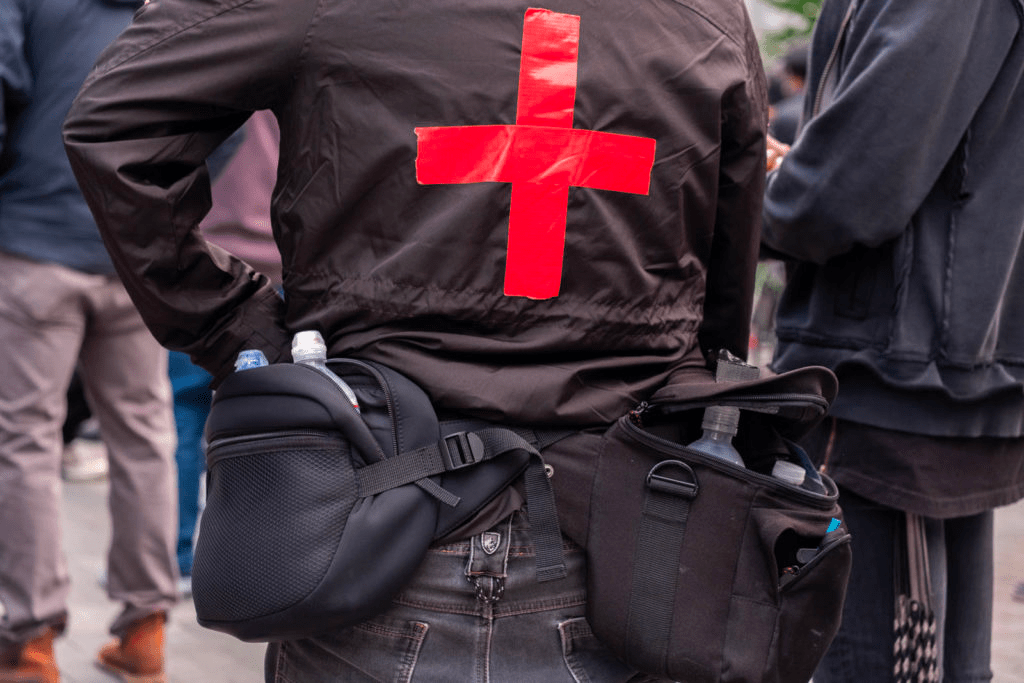
Trained street medics mark themselves with certain symbols while they are performing a medic role to indicate that they are active and available for support. We make ourselves easily identifiable with red duct tape or medic patches on our clothes and kits, often in the shape of a Red Cross or Star of Life. You can also shout “medic!” and form an “X” with your arms over your head.
What are some practices I should or shouldn’t expect of NYCAM-trained medics?
NYCAM-trained medics DO:
- Offer care, medical support, health information, and resources to protestors, movements, and communities we align ourselves with, including those fighting for Black liberation, a free Palestine, and abolition of carceral systems.
- Practice radical consent, respect a patient’s refusal of care, and recognize that a person can revoke their consent to treatment at any point. This respect includes community members who appear to be intoxicated, are using substances, or are experiencing altered realities.
- Strive to spread calm and be a grounding presence. We avoid antagonizing the police while marked, as it can further endanger our patients.
NYCAM-trained medics DO NOT:
- Collaborate with police or treat members of law enforcement or military while on-duty as street medics. To understand why we take this position, please refer to Critical Resistance’s resources on police abolition.
- Call 911 without the explicit consent or request of a patient. When we have to call 911, we take steps to mitigate the harm that calling 911 can cause for the patient, their community, and those in their immediate vicinity.
- Tell protesters and organizers what to do. We recognize our power and perceived authority as care providers and avoid interfering with protest tactics and “taking sides” in tactical disagreements.
NYCAM-trained medics recognize that the medical industrial complex was founded on stolen land, genocide, settler colonialism, chattel slavery, human experimentation and vivisection, and the forced institutionalization and incarceration of oppressed communities. The medical profession and formal medical settings continue to be sites of white supremacist, heteropatriarchal, transphobic, ableist, saneist, and xenophobic violence. It is the personal and collective responsibility of street medics to learn about this history and reality, to unlearn oppressive beliefs and behavior, and to contribute to a more care-centered world.
I had a negative experience with a street medic. What do I do?
We are so sorry this happened!
Please email us at NYCActionMedical@proton.me about the incident. We take feedback and community accountability seriously and are deeply informed by and grounded in practices of Transformative Justice.
If this person is a member of our collective or our Dispatch, we will respond to schedule a conversation with you, if you feel comfortable. If this person is not a member of our collective or our Dispatch, our ability to address the harm is limited, but we will do our best to incorporate feedback into collective learning, including in our trainings.
Is it true that you can use [not water] to help someone who has been pepper sprayed or tear gassed?
NYCAM only recommends using clean water for flushing chemical weapons (including pepper spray and tear gas) out of the eyes, and water and soap/dish detergent for the skin.
Our goal is to mechanically flush the chemical out of the eyes with water; we are not trying to counteract the weapon. Eyeballs are not safe places to perform chemical experiments!
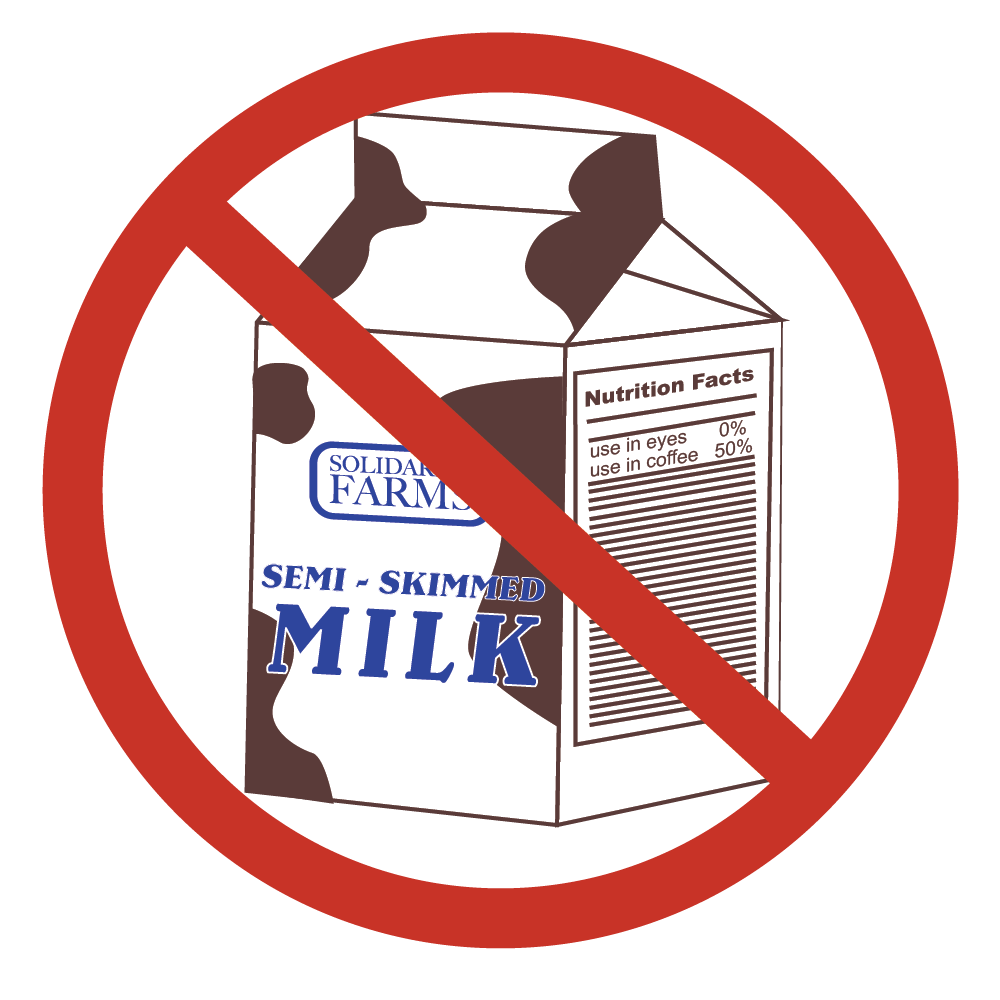
Dairy contains bacteria and can cause infections. Dairy is also a common allergen and can cause life-threatening allergic reactions. Dairy will spoil when carried outside during actions.
Liquid Antacid and Water (LAW), sometimes referred to by the brand name Maalox, leaves behind a chalky white substance when it dries, which can mark darker-skinned patients and make them targets for further police violence. There is also no evidence that LAW works any better than water.
0.9% Saline and Sudecon are effective for the eyes and skin, respectively, but they are less accessible to most people and expensive in large quantities. Using these substances can also perpetuate the myth that chemical weapons treatment is complex and requires specialized equipment or medicine.
Water is safe, effective, accessible, affordable, and multipurpose. It can be used to hydrate, to clean wounds, to cool down folks with heat illnesses, and for eye flushes. Demystifying and democratizing chemical weapons treatment allows us to build collective power against state violence.
For more information, see this article from the American Academy of Ophthalmology.
 New York City Action Medical