What is street medicine?
Street medicine is part of a wider abolitionist movement rooted in the histories and healing practices of survivors of colonization, occupation, enslavement, and systemic violence.
Street medicine is grounded in healing justice – a framework that aims to address and transform the impacts of oppression, trauma, and violence in communities while focusing on reclaiming community care to restore collective autonomy.
Street medicine recognizes and centers the lived experiences of oppressed people in our practice of care and medicine.
Street medicine addresses the ways that medicine as an institution has been weaponized to control and harm our communities and seeks to dismantle the medical industrial complex.
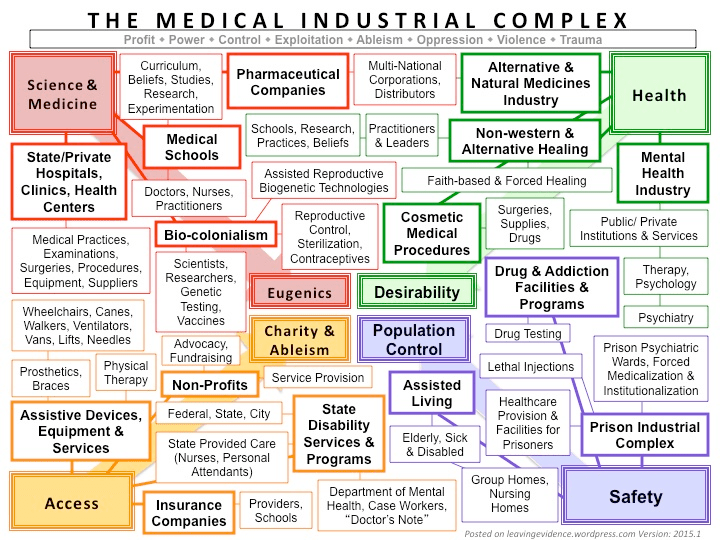
Image Description: The image shows a visual layout of the Medical Industrial Complex, which is written at the top in large letters. Just under it, there is a thin, long box that contains the words: Profit, Power, Control, Exploitation, Ableism, Oppression, Violence, Trauma. There are four main quadrants, each in a different color with large matching colored arrows connecting the outer broad categories to inner underlying motives: “Science and Medicine” is connected to “Eugenics;” “Access” to “Charity and Ableism;” “Health” to “Desirability;” and “Safety” to “Population Control.” Subcategories and main categories within each quadrant, are listed in large and small boxes that are all connected to each other with lines, forming a web-like effect, filling the entire page. In the bottom right corner there is small grey lettering that reads, “Posted on leavingevidence.wordpress.com Version: 2015.1.”
Learn more about the history of street medicine through our archive.
What is a street medic?
Street medics are a community of people who provide medical support:
- At protests, uprisings, and direct actions
- At occupations, encampments, and tent cities
- At sites of community defense (e.g. libraries, schools, and abortion clinics)
- At jails and precincts
- During natural disasters and climate collapse
- To street communities (sex workers, addicts, drug users, and unhoused people)
- Particularly where police and/or military target oppressed and marginalized people
Becoming a street medic involves:
- Completing a 20-28 hour training (or a bridge training for medical professionals)
- Working at a direct action as the buddy of an experienced street medic
- Maintaining relationships with street medic communities
- Actively seeking out opportunities and trainings for continuing medical education
What is action medical?
Action medical is the provision of care at sites of resistance and struggle, including the diverse and challenging environments offered by uprisings, protests, blockades, occupations, encampments, marches, strikes, civil disobedience, and other direct actions.
In the so-called US, action medical has historically been provided by trained street medics. However, action medical responses may also be offered by lay first-aiders, firefighters, and medical professionals who are not trained as street medics.
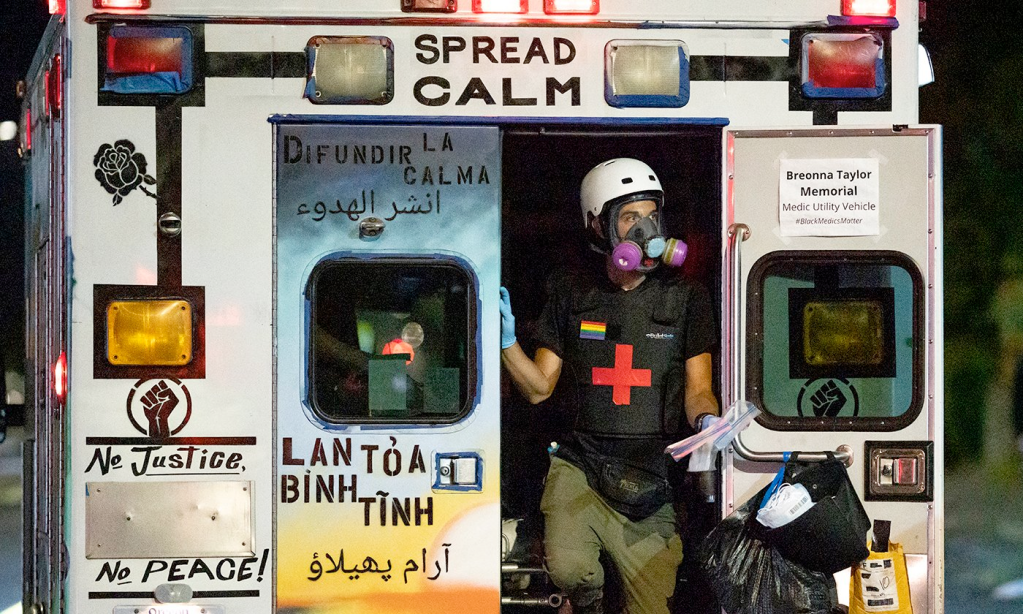
Image Description: A photograph of a street medic wearing a P100 respirator, white helmet, pride flag, and vest with red tape in a cross symbol hands out masks, while watching the crowd pass from the back of an ambulance during a protest against racial injustice and police brutality on Sept. 5, 2020 in Portland, Oregon. The ambulance is covered in words and images, spray-painted or drawn with marker, including “No Justice, No Peace!” and “Spread Calm” in different languages, including English, Spanish, Vietnamese, and Arabic. A paper sign is taped on the door on the viewer’s right, which says “Breonna Taylor Memorial Medic Utility Vehicle #BlackMedicsMatter.” Photo by Nathan Howard.
Source: Yes Magazine
What is community medicine?
Community medicine is people-led and people-centered care that aims to support the well-being of oppressed communities. Street medics and everyday neighbors serve local communities and offer alternatives to the formal medical system by:
- Setting up pop-up clinics
- Providing care for people without housing
- Assisting larger health organizations with on-the-ground outreach
- Organizing home care for elders/disabled comrades
- Offering mental health support, harm reduction, and safe injection/use sites
- Supporting food and mutual aid distributions
- Promoting community health education
- Engaging in gender-affirming care, access, and advocacy
- Providing reproductive care, including doula and midwifery support
How do medics organize?
Street medics typically organize as affinity group medics, in medic affinity groups, or in medic collectives.
An affinity group is a group of people who come together to accomplish a shared objective. Sometimes the goal is tactical, such as a direct action; sometimes the goal is logistical, such as providing food, water, or medical support to a community.
Street medic affinity groups are affinity groups that solely provide action medical services and exist to support mobilizations and direct actions, usually in a particularly geographic region. Since a street medic affinity group is committed to serving all the groups at a protest, they are typically marked and are bound by tactical neutrality. Abiding by tactical neutrality means that while marked, street medics do not participate in tactics or roles other than action medical. Marked street medics support a diversity of tactics, refrain from offering input on tactical decision-making, and do not direct, control, or police an action or protestors.
Affinity group medics, also known as embedded medics, are medics that exist within and support a specific affinity group or organization with its goal or mission. These medics are often unmarked, meaning they do not wear red tape, crosses, patches, or other symbols to indicate they are serving in a medic role. While an affinity group medic may help people outside the team they are a part of, their primary responsibility is to the group. Unlike marked street medics, affinity group medics are not bound by the expectation of tactical neutrality.
Street medic collectives often form out of street medic affinity groups. They have Points of Unity and a formal covenant that describes how decisions are made and how membership is defined. Street medic collectives engage in radical community health organizing in between direct actions. NYCAM is a street medic collective!
 New York City Action Medical